
Back to Speciality Products
Bio-Fungicide
Eco-Friendly
Broad Spectrum
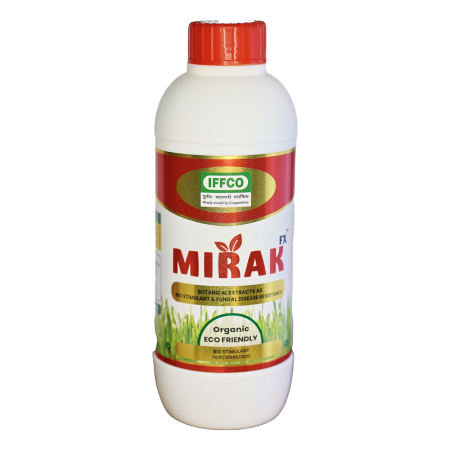
MIRAK - Fx
Advanced Bio-Fungicide with Phytovolatile Extracts and Polymer Technology
Key Features
Advanced Polymer Technology: Utilizes state-of-the-art polymer delivery systems for enhanced bioavailability and sustained release
Phytovolatile Extracts: Contains 3% w/w concentrated aromatic secondary metabolites with proven antifungal properties
Dual Action Formula: Combines antifungal protection with plant growth enhancement bioactives
Broad Spectrum Efficacy: Effective against multiple fungal pathogens affecting diverse crop species
Eco-Friendly Formulation: Natural phytoextract-based solution with minimal environmental impact
Enhanced Absorption: Polymer technology ensures superior penetration and absorption in plant systems
Unique Selling Propositions
USP 1
First-in-Class: Revolutionary phytovolatile extract formulation using polymer technology
USP 2
Multi-Modal Action: Disrupts fungal cell walls, membranes, and cytoplasm while promoting plant health
USP 3
Versatile Application: Compatible with foliar spray, drip irrigation, and fertilizer mixing
USP 4
Sustainable Solution: Reduces dependency on synthetic chemical fungicides
USP 5
Cost-Effective: Lower application rates with higher efficacy compared to conventional fungicides
Product Composition
| Component | Concentration | Function |
|---|---|---|
| Phytovolatile Extracts | 3.0% w/w | Active antifungal agents, aromatic secondary metabolites |
| Deionized Excipients | 97.0% w/w | Polymer delivery system, essential oils, stabilizers |
| Essential Oils | Enriched | Synergistic antifungal activity, plant growth promotion |
| Polymer Carriers | Proprietary | Enhanced bioavailability and controlled release |
Physical & Chemical Properties
Physical State
Liquid concentrate
Odor
Characteristic aromatic (essential oils)
Specific Gravity
1.02 - 1.08 g/cm³
Solubility
Completely miscible in water
Storage Temperature
5°C - 35°C
Color
Amber to dark brown
pH
6.0 - 7.5
Viscosity
15-25 cP at 25°C
Shelf Life
24 months from date of manufacture
Primary Mechanisms
1. Cell Membrane Disruption
Hydrophobic components alter microbial cell membrane permeability for cations (H⁺ and K⁺)
2. Cell Wall Degradation
Disrupts fungal cell wall integrity through enzymatic and chemical breakdown
3. Cytoplasm Coagulation
Causes coagulation of fungal cytoplasm, leading to cell death
4. Organelle Damage
Damages cellular organelles, disrupting vital metabolic processes
5. Growth Inhibition
Prevents spore germination and mycelial growth
Secondary Benefits
Enhanced nutrient uptake efficiency
Improved root development
Increased stress tolerance
Boosted natural plant defense mechanisms
Foliar Spray Application
Dilution Rate
5 ml per liter of water (0.5% solution)
Application Frequency
2-3 applications at 15-day intervals
Water Volume
500-750 liters per hectare
Optimal Timing
Early morning (6-10 AM) or late evening (4-7 PM)
Spray Coverage: Ensure uniform coverage of upper and lower leaf surfaces
Drip Irrigation (Fertigation)
Concentration
2.5-3.0 ml per liter of irrigation water
Frequency
Weekly applications during critical growth stages
Application Duration
During regular irrigation cycles
Benefits: Root zone protection, reduced labor costs, water conservation
Soil Application
Rate
2.5-3.0 liters per hectare
Timing
Pre-planting or early vegetative stage
Method
Mix with irrigation water or apply as soil drench
Coverage: Ensure even distribution in root zone
Tank Mixing Compatibility
Compatible Products
- NPK fertilizers (19:19:19, 20:20:20)
- Micronutrient formulations
- Bio-stimulants and plant growth promoters
- Organic manures (liquid form)
- Other bio-pesticides
Incompatible Products
- Strong alkaline solutions (pH > 8.5)
- Copper-based fungicides
- Highly concentrated acidic formulations
Application Guidelines by Crop Growth Stages
Cereals (Rice/Wheat)
Stage 1: Tillering stage (1st application)
Stage 2: Booting/Flag leaf emergence (2nd application)
Stage 3: Grain filling stage (3rd application if required)
Vegetables (Tomato/Brinjal/Chili)
Stage 1: 4-6 leaf stage (1st application)
Stage 2: Flowering initiation (2nd application)
Stage 3: Fruit development (3rd application)
Stage 4: Peak harvest period (4th application if required)
Cash Crops (Cotton/Sugarcane)
Stage 1: Early vegetative stage (1st application)
Stage 2: Squaring/Elongation stage (2nd application)
Stage 3: Flowering/Maturity stage (3rd application)
Environmental Safety Profile
Eco-toxicity Class
Class IV (Practically Non-toxic)
Bioaccumulation Potential
Low (Log Kow < 3.0)
Biodegradability
>90% biodegradable within 28 days
Soil Half-life
<7 days under field conditions
Water Solubility
High, no groundwater contamination risk
Non-Target Organism Safety
Beneficial Insects
Parasitic Wasps
Compatible with IPM programs
Honey Bees (Apis mellifera)
Non-toxic at recommended rates
Predatory Mites
No adverse effects observed
Earthworms
No significant impact on soil fauna
Aquatic Organisms
Fish Toxicity (LC50)
>100 ppm (96 hours)
Daphnia Toxicity (EC50)
>100 ppm (48 hours)
Algae Growth Inhibition
<10% at max concentration
Carbon Footprint Analysis
Manufacturing
60% lower CO₂ emissions compared to synthetic fungicides
Transportation
Concentrated formulation reduces shipping volume
Application
Reduced application frequency decreases fuel consumption
Overall Impact
45% reduction in carbon footprint per hectare treated
Personal Protective Equipment (PPE)
Respiratory Protection
Not required for normal use
Eye Protection
Safety goggles recommended during mixing
Skin Protection
Rubber gloves and long-sleeve clothing
Foot Protection
Closed-toe shoes or boots
Safe Handling Practices
Mixing: Use clean water and equipment, avoid splashing
Application: Follow label directions for rate and timing
Storage: Keep in original container, away from children
Disposal: Triple-rinse containers, follow local regulations
Toxicological Profile
Acute Oral Toxicity
LD50 > 5000 mg/kg (rats)
Practically non-toxic
Acute Dermal Toxicity
LD50 > 2000 mg/kg (rabbits)
Non-toxic
Eye Irritation
Mild irritant
Rinse with water if contact occurs
Skin Sensitization
Non-sensitizing
Safe for normal handling
First Aid Measures
Inhalation
Move to fresh air, seek medical attention if symptoms persist
Eye Contact
Rinse immediately with water for 15 minutes
Skin Contact
Wash with soap and water, remove contaminated clothing
Ingestion
Do not induce vomiting, seek immediate medical attention
Manufacturing Quality Standards
Raw Material Quality
- Source Verification: Certified suppliers with quality agreements
- Incoming Inspection: 100% testing of active ingredients
- Batch Certification: Certificate of analysis for each batch
- Traceability: Complete supply chain tracking
Production Quality Control
- In-process Monitoring: Real-time quality parameters
- Statistical Process Control: Continuous improvement methodology
- Clean Room Standards: Contamination-free manufacturing environment
- Equipment Validation: Regular calibration and maintenance
Stability and Shelf Life
Accelerated Studies
40°C ± 2°C, 75% ± 5% RH
Real-time Studies
25°C ± 2°C, 60% ± 5% RH
Freeze-thaw Stability
Stable through 5 cycles
Photostability
UV protected formulation
Product Quality Specifications
Mixing: Use clean water and equipment, avoid splashing
Application: Follow label directions for rate and timing
Storage: Keep in original container, away from children
Disposal: Triple-rinse containers, follow local regulations
Toxicological Profile
Active Ingredient Content
Specification:
3.0% ± 0.2% w/w
Test Method:
GC-MS
Acceptance Criteria
2.8 - 3.2% w/w
Testing Frequency:
2.8 - 3.2% w/w
Physical Properties
pH:
6 - 9
Specific Gravity:
1.02 - 1.08 g/cm³
15 - 25 cP at 25°C
15 - 25 cP at 25°C
Particle Size:
<10 microns (99% distribution)
Registration Status
CIB&RC Registration
Applied under Section 9(3) - New Product Registration
Registration Category
Biological/Botanical Fungicide
Application Number
[Pending Regulatory Approval]
Provisional Registration
Under consideration for field trials
Regulatory Framework Compliance
Central Insecticides Board & Registration Committee (CIB&RC)
- Data Requirement: Comprehensive dossier submitted as per CIB&RC guidelines
- Bio-efficacy Trials: Conducted at State Agricultural Universities (SAUs)
- Safety Studies: Acute toxicity, chronic toxicity, and environmental impact studies
- Quality Standards: Manufacturing as per BIS specifications
Food Safety Standards Authority of India (FSSAI)
- Residue Studies: Maximum Residue Limit (MRL) determination ongoing
- Pre-harvest Interval (PHI): 7-14 days depending on crop
- Dietary Risk Assessment: Within acceptable daily intake (ADI) limits
- Export Compliance: Meets international food safety standards
Manufacturing Standards
CIB&RC Registration
Quality Management System certified facility
ISO 14001:2015
Environmental Management System compliance
WHO-GMP
Good Manufacturing Practices implementation
BIS Standards
Bureau of Indian Standards compliance for pesticide formulations
Transport and Storage Regulations
Classification
Non-hazardous for transport (Green Label expected)
Storage Class
Store in original containers, away from direct sunlight
Temperature Range
5°C to 35°C
Shelf Life
24 months under recommended storage conditions